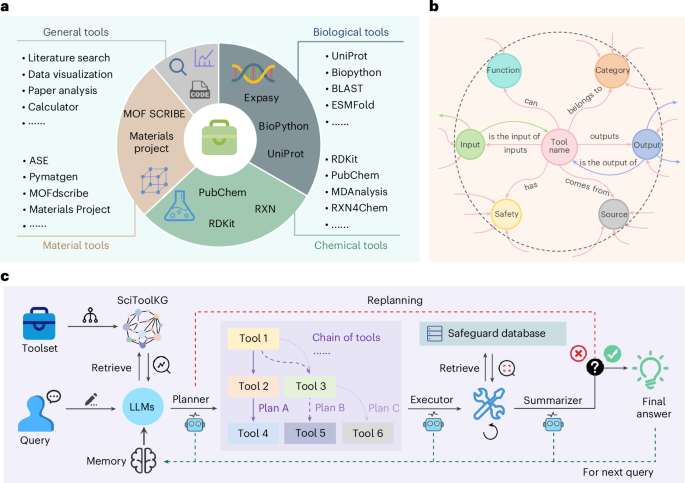
SciToolAgent: a knowledge-graph-driven scientific agent for multitool integration
Birhane, A., Kasirzadeh, A., Leslie, D. & Wachter, S. Science in the age of large language models. Nat. Rev. Phys. 5, 277–280 (2023).
Schick, T. et al. Toolformer: language models can teach themselves to use tools. Adv. Neural Inf. Process. Syst. 36, 68539–68551 (2023).
Yang, R. et al. GPT4Tools: teaching large language model to use tools via self-instruction. Adv. Neural Inf. Process. Syst. 36, 71995–72007 (2024).
Guo, T. et al. What can large language models do in chemistry? A comprehensive benchmark on eight tasks. Adv. Neural Inf. Process. Syst. 36, 59662–59688 (2023).
Zhao, W. X. et al. A survey of large language models. Preprint at (2023).
Min, B. et al. Recent advances in natural language processing via large pre-trained language models: a survey. ACM Comput. Surveys 56, 1–40 (2023).
Wang, L. et al. A survey on large language model based autonomous agents. Front. Comput. Sci. 18, 186345 (2024).
Ramos, M. C., Collison, C. J. & White, A. D. A review of large language models and autonomous agents in chemistry. Chem. Sci. 16, 2514–2572 (2025).
Boiko, D. A., MacKnight, R., Kline, B. & Gomes, G. Autonomous chemical research with large language models. Nature 624, 570–578 (2023).
Janakarajan, N., Erdmann, T., Swaminathan, S., Laino, T. & Born, J. Language models in molecular discovery. In Drug Development Supported by Informatics (eds Satoh, H. et al.) 121–141 (Springer, 2024).
Bran, A. M. et al. Augmenting large language models with chemistry tools. Nat. Mach. Intell. 6, 525–535 (2024).
McNaughton, A. D. et al. CACTUS: chemistry agent connecting tool usage to science. ACS Omega 9, 46563–46573 (2024).
Jin, Q., Yang, Y., Chen, Q. & Lu, Z. GeneGPT: augmenting large language models with domain tools for improved access to biomedical information. Bioinformatics 40, btae075 (2024).
Huang, K. et al. CRISPR-GPT: an LLM agent for automated design of gene-editing experiments. Preprint at (2024).
Liu, H. & Wang, H. GenoTEX: a benchmark for evaluating LLM-based exploration of gene expression data in alignment with bioinformaticians. Preprint at (2024).
Ghafarollahi, A. & Buehler, M. J. ProtAgents: protein discovery via large language model multi-agent collaborations combining physics and machine learning. Digital Discovery 3, 1389–1409 (2024).
Jia, S., Zhang, C. & Fung, V. LLMatDesign: autonomous materials discovery with large language models. Preprint at (2024).
Kang, Y. & Kim, J. ChatMOF: an artificial intelligence system for predicting and generating metal–organic frameworks using large language models. Nat. Commun. 15, 4705 (2024).
Wu, H. et al. ChatEDA: a large language model powered autonomous agent for EDA. IEEE Trans. Comput.-Aided Design Integr. Circuits Syst. 43, 3184–3197 (2024).
Ni, B. & Buehler, M. J. MechAgents: large language model multi-agent collaborations can solve mechanics problems, generate new data, and integrate knowledge. Extreme Mech. Lett. 67, 102131 (2024).
Yao, S. et al. ReAct: synergizing reasoning and acting in language models. In International Conference on Learning Representations (2023).
He, J. et al. Control risk for potential misuse of artificial intelligence in science. Preprint at (2023).
Liu, X. et al. ToolNet: connecting large language models with massive tools via tool graph. Preprint at (2024).
Hao, S., Liu, T., Wang, Z. & Hu, Z. ToolkenGPT: augmenting frozen language models with massive tools via tool embeddings. Adv. Neural Inf. Process. Syst. 36, 45870–45894 (2024).
Shinn, N., Cassano, F., Gopinath, A., Narasimhan, K. & Yao, S. Reflexion: language agents with verbal reinforcement learning. Adv. Neural Inf. Process. Syst. 36, 8634–8652 (2024).
Ingraham, J. B. et al. Illuminating protein space with a programmable generative model. Nature 623, 1070–1078 (2023).
Lin, Z. et al. Evolutionary-scale prediction of atomic-level protein structure with a language model. Science 379, 1123–1130 (2023).
Google Scholar
Atilgan, A. R. et al. Anisotropy of fluctuation dynamics of proteins with an elastic network model. Biophys. J. 80, 505–515 (2001).
Bakan, A., Meireles, L. M. & Bahar, I. Prody: protein dynamics inferred from theory and experiments. Bioinformatics 27, 1575–1577 (2011).
Cock, P. J. et al. Biopython: freely available Python tools for computational molecular biology and bioinformatics. Bioinformatics 25, 1422 (2009).
Schwaller, P. et al. Molecular transformer: a model for uncertainty-calibrated chemical reaction prediction. ACS Central Science 5, 1572–1583 (2019).
Pei, Q. et al. BioT5+: towards generalized biological understanding with IUPAC integration and multi-task tuning. In Findings of the Association for Computational Linguistics: ACL 2024, 1216–1240 (Association for Computational Linguistics, 2024).
Papadatos, G. et al. SureChEMBL: a large-scale, chemically annotated patent document database. Nucleic Acids Res. 44, D1220–D1228 (2016).
Kim, S. et al. Pubchem substance and compound databases. Nucleic Acids Res. 44, D1202–D1213 (2016).
Bobbitt, N. S. et al. MOFX-DB: an online database of computational adsorption data for nanoporous materials. J. Chem. Eng. Data 68, 483–498 (2023).
Nandy, A. et al. Mofsimplify, machine learning models with extracted stability data of three thousand metal–organic frameworks. Sci. Data 9, 74 (2022).
Dubbeldam, D., Calero, S., Ellis, D. E. & Snurr, R. Q. RASPA: molecular simulation software for adsorption and diffusion in flexible nanoporous materials. Molecular Simulation 42, 81–101 (2016).
BLAST: basic local alignment search tool. NIH (2024).
RDKit: open-source cheminformatics software. RDKit (2024).
Bajusz, D., Rácz, A. & Héberger, K. Why is tanimoto index an appropriate choice for fingerprint-based similarity calculations? J. Cheminformatics 7, 1–13 (2015).
Smith, T. F. et al. Identification of common molecular subsequences. J. Mol. Biol. 147, 195–197 (1981).
Hu, E. J. et al. LoRA: low-rank adaptation of large language models. In International Conference on Learning Representations (2022).
Vaswani, A. et al. Attention is all you need. Adv. Neural Inf. Process. Syst. 30, 5998–6008 (2017).
Yu, J. Dataset for the paper “SciToolAgent: A knowledge graph-driven scientific agent for multi-tool integration”. Zenodo (2025).
Yu, J. & Ding, K. HICAI-ZJU/SciToolAgent: V1.0.1. Zenodo (2025).
link


.jpg "IFW Dresden selects Agnitron Agilis 100 MOCVD platform for precursor chemistry and ultra-wide-bandgap materials development")