US opens world-first self-driving robot lab for next-gen quantum tech
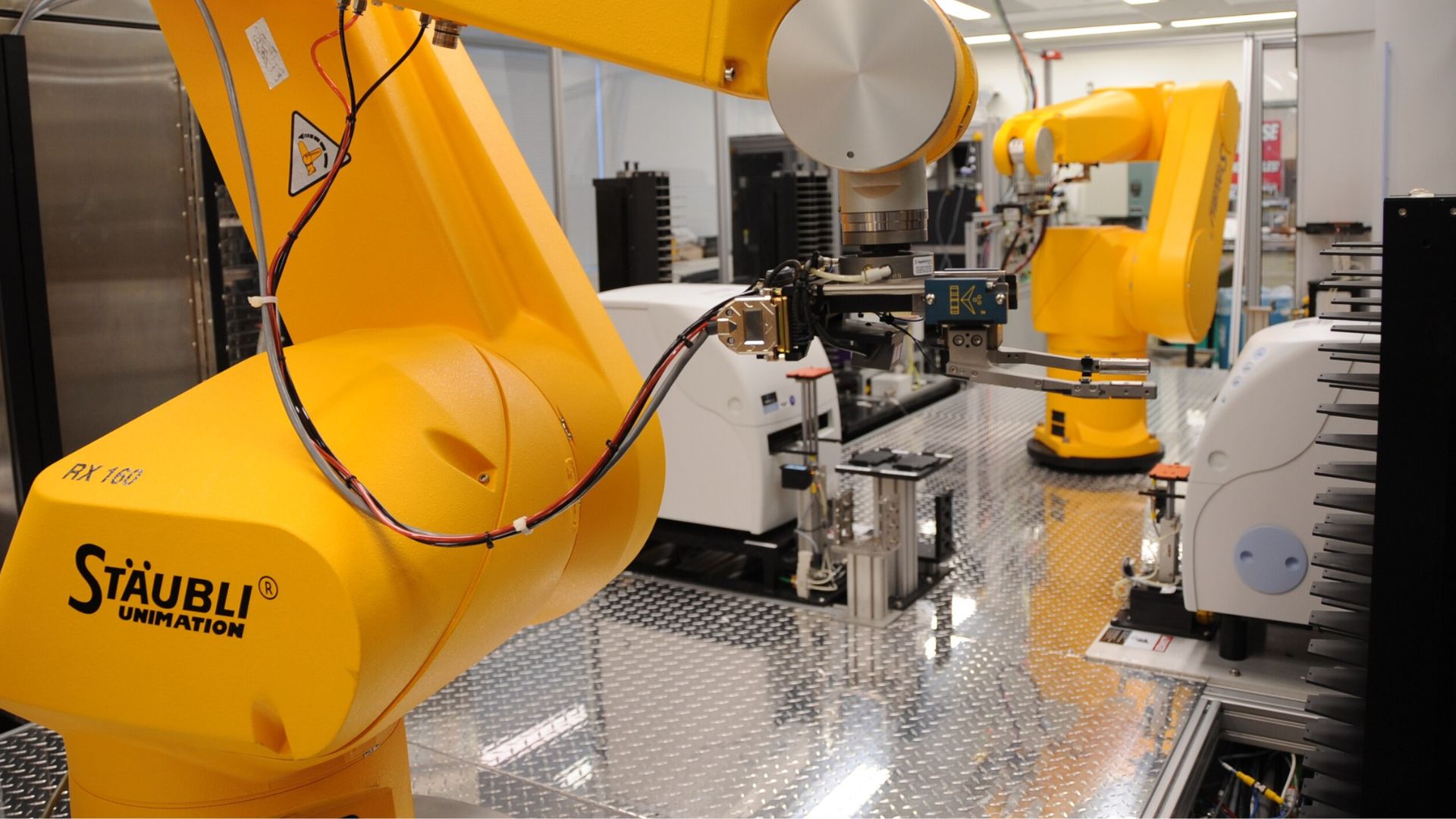
Researchers at North Carolina State University have developed a first-of-its-kind self-driving laboratory that uses multiple robots and artificial intelligence to accelerate the discovery of quantum dots, semiconductor nanoparticles seen as vital for future displays, solar cells, LEDs, and quantum technologies.
The Rainbow system can carry out and analyze up to 1,000 experiments daily without human assistance, far outpacing traditional laboratory methods.
“Rainbow brings together multiple robots working in concert to explore and optimize complex chemistries with extraordinary efficiency autonomously,” said Milad Abolhasani, corresponding author of the study and a professor of chemical and biomolecular engineering at NC State.
“Rainbow doesn’t sleep; it works around the clock, performing in days what would take human researchers years.”
How it works
Rainbow’s network of robots handles every step of an experiment. The machines prepare chemical precursors, mix them, and run up to 96 reactions at once using miniaturized batch reactors.
The products are then transferred to a characterization robot, which evaluates the results using real-time optical analysis.
Machine learning algorithms guide the next round of experiments by identifying promising directions.
Users start by selecting a target property for the quantum dots, such as emission wavelength or energy bandgap, and setting an experimental “budget” that defines how many trials Rainbow should perform.
From there, the system operates independently, designing and executing the sequence of experiments to find the most efficient synthesis recipe.
“Rainbow is not designed to replace scientists,” Abolhasani said.
“It’s built to empower them by handling the tedious, time-intensive parts of discovery so they can focus on design and innovation.”
From discovery to manufacturing
The project represents a significant expansion of Abolhasani’s earlier work on self-driving labs.
The robotic design allows Rainbow to test a broader range of chemical precursors, which increases the chances of discovering novel and high-performing quantum dots.
“Because we are not confined to a fixed set of precursors, there is a wider range of potential outcomes in terms of what the highest quality quantum dot will be made of,” Abolhasani said.
The system can also explore variations in ligand structures, molecules that bind to the surface of the nanocrystals, which play an important role in determining their properties.
Abolhasani said the advantage lies not only in speed but in understanding. “With Rainbow, we’ve built a system that not only finds the best quantum dots faster than ever before, but also tells us why they work,” he said.
Once the platform identifies the most effective synthesis method, it can be adapted to run larger reactors for industrial production. “Rainbow makes scaling up a seamless transition,” Abolhasani said.
The team’s findings are detailed in the paper “Autonomous multi-robot synthesis and optimization of metal halide perovskite nanocrystals,” published in Nature Communications.
First author Jinge Xu, a Ph.D. student at NC State, led the study. Co-authors include several graduate students, postdoctoral researchers, undergraduates, and collaborators who previously worked at the university.
Abolhasani said the goal is to expand Rainbow’s applications beyond quantum dots to other complex materials, potentially transforming the pace of materials science.
link


.jpg "IFW Dresden selects Agnitron Agilis 100 MOCVD platform for precursor chemistry and ultra-wide-bandgap materials development")