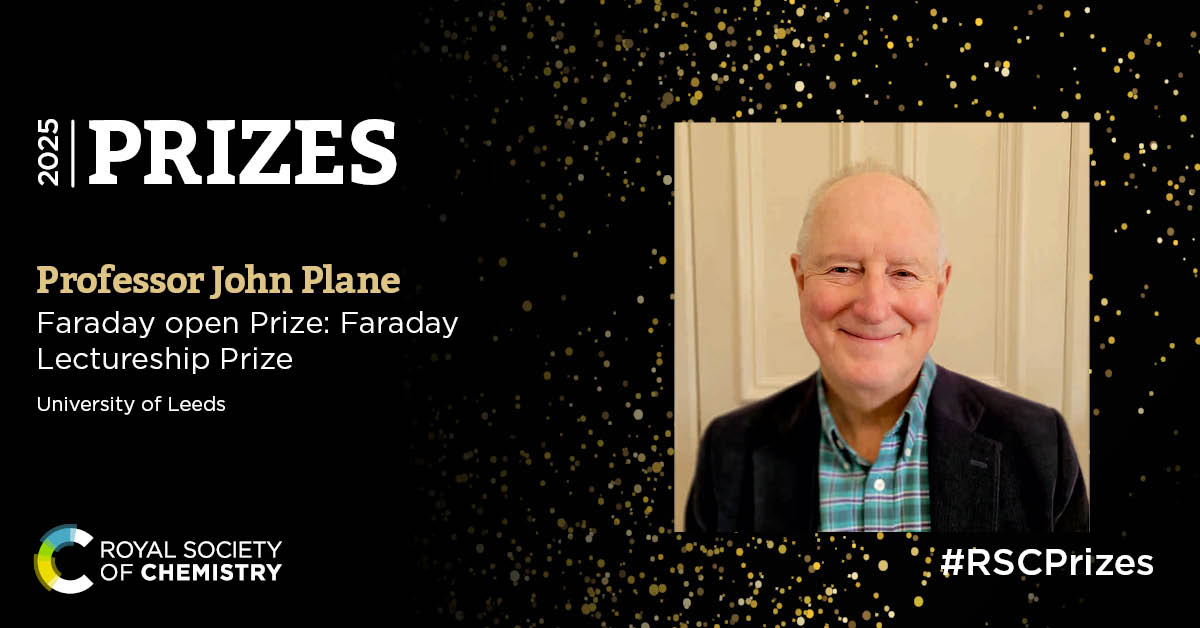
Professor John Plane
John Plane studies the chemistry of planetary atmospheres and space. He is currently exploring how cosmic dust forms around “red giant” stars as they near the end of their lives. This dust can later collapse into a disc from which new solar systems are born, giving rise to planets and moons. Some of this leftover dust also ends up in comets – large balls of icy dust.
When comets travel into the inner solar system, the Sun warms them, causing the ice and dust to evaporate. This dust can then enter a planet’s atmosphere, such as Earth’s, when the planet’s path crosses the comet’s orbit. The dust particles hit Earth’s atmosphere at very high speeds (between 40,000 and 260,000 km/h). Most of the dust vaporises, releasing metals like sodium, iron and magnesium. These metals create thin layers of atoms around 90 km above Earth’s surface.
Scientists can measure these layers using lasers (a technique called lidar) or satellites. These measurements help us study this part of the atmosphere, which is hard to reach in other ways. The metals also act as markers, showing us how the atmosphere moves and changes – including features like atmospheric tides and waves. This part of the atmosphere is sensitive to climate change and to “space weather” from solar particles. The metals can become charged, creating layers of ions called sporadic E layers, which affect radio communications on Earth and between Earth and space.
Below 90 km, the metals form tiny solid particles, which help to create noctilucent clouds – thin, high-altitude clouds made of ice crystals. First seen in 1886 at high latitudes in summer, these clouds have been getting brighter and more widespread over the last 50 years. This change suggests that the middle atmosphere is cooling because of greenhouse gases, which act like a coolant at low pressures.
John’s current research also looks at how these “meteoric” metals behave in the atmospheres of Mars and Venus. His work combines lab experiments, theoretical studies of chemical reaction rates, lidar, satellite and telescope observations, and computer models of planetary atmospheres and the space around stars.
Biography
John Plane has been Professor of Atmospheric Chemistry in the School of Chemistry at Leeds since 2006. He was raised in South Africa, did his BA and PhD degrees at the University Cambridge (1976-1984), and was a research fellow at St. John’s College, Cambridge from 1982 to1985. He was then an assistant/associate professor at the University of Miami, Florida, before moving to the University of East Anglia as Reader and Professor between 1991 and 2006.
John uses fundamental experimental and theoretical chemistry to investigate a broad range of phenomena in environments ranging from the upper ocean to dust formation around stars. He has pioneered techniques for studying gas-phase reactions of metallic species, and is a leading expert on the chemistry of metals that evaporate or burn off from cosmic dust particles when they enter planetary atmospheres. He has also made significant contributions to understanding the chemistry of the Earth’s lower atmosphere – particularly the field of iodine chemistry – using a combination of observations, laboratory studies and atmospheric modelling.
John has authored over 420 peer-reviewed papers and 17 book chapters, with more than 23,000 citations. He has been awarded the RSC prize in Reaction Kinetics and Mechanisms, the RSC Tilden prize, the NSF CEDAR Lecture Prize, the EGU Vilhelm Bjerknes Medal for Atmospheric Science, and the AGU Marcel Nicolet lecture. He was elected an AGU Fellow (2017), a Fellow of the Royal Society (2020), and a member of the Academia Europaea (2022). He has trained 29 PhD students and had 24 post-docs in his research group.
The first paper I published back in 1981 was in the Faraday Transactions (later incorporated into Physical Chemistry Chemical Physics), so there is a sense of continuity with the Faraday name!
Professor John Plane
link


.jpg "IFW Dresden selects Agnitron Agilis 100 MOCVD platform for precursor chemistry and ultra-wide-bandgap materials development")