Luminescent Materials: Learning to Glow

Chemistry’s Erin Finley Finds Opportunity in Graduate School
Luminescent materials give off light without emitting heat. Their uses range from
watch-dials that glow in the dark and glow-sticks used to direct night-time traffic,
to diagnostics that glow in the presence of specific microbes.
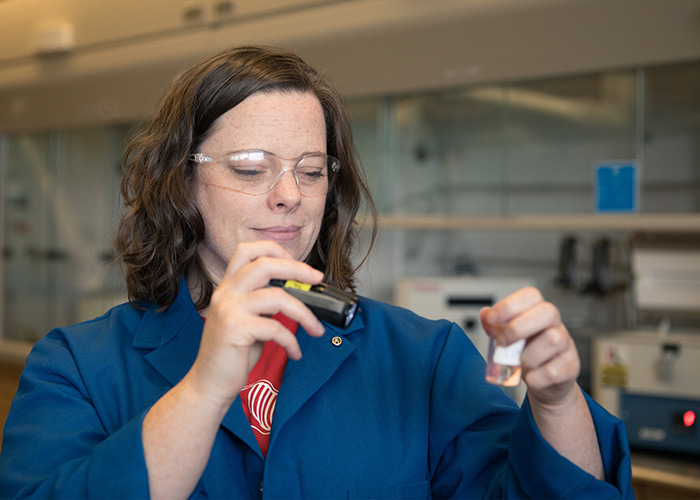 Erin Finley, a Ph.D. student in chemistry, specializes in the synthesis and characterization
of luminescent materials.Erin Finley, a University of Houston Ph.D. student in chemistry, specializes in the
synthesis and characterization of luminescent materials.
Solid-State Chemistry: ‘Beat and Heat’
Finley’s research is in a field known as solid-state chemistry, which studies the
synthesis and properties of solid materials. This research is conducted in the lab
of Jakoah Brgoch, assistant professor of chemistry in the College of Natural Sciences
and Mathematics.
“The simplest way to describe solid-state chemistry is ‘beat and heat,’” Finley said.
“We take powders, grind them together and then heat them at thousands of degrees Celsius
for hours at a time.”
Practically speaking, this means certain constraints on how materials can be made,
and what type.
“The only thing we can control is temperature and pressure, unlike an organic chemist,
who can also control the rates of their reactions,” Finley said.
Luminescent Materials for Use in Test Strips
Finley’s research focuses on synthesizing powders for use in test strips. Similar
to the way that pregnancy tests work, these test strips would glow a certain color
in the presence of a specific compound. This could be used to make a mobile testing
unit to attach to a smartphone.
“If you are in a remote area and need to diagnose someone quickly, this is something
a doctor could do very easily,” Finley said.
“Erin has been the main driver of this research, with a dedication toward publishing
high quality research,” Brgoch said. “She has a bright future in materials chemistry.”
The Role of Mentors
Finley enrolled in college as an adult, after spending a decade working as a dental
assistant.
“One of the doctors I worked for wanted me to understand what he was doing, and the
reasons why he was doing it,” Finley said. “We were doing a root canal, and he started
explaining the materials behind the root canal to me, what we were doing, and why
it was important.”
After this tutorial, Finley found herself fascinated by the idea of manufacturing
materials that can then be used for medical purposes. Still, she was happy with her
job.
“One day this doctor said to me, ‘You are too smart to be a dental assistant for the
rest of your life,’” Finley said. “I said, ‘Well, I’m OK with that,’ and he said to
me, ‘I need you to not be OK with that.’”
After enrolling in a community college, Finley became interested in research, which
she credits to a series of supportive professors. She eventually transferred to Penn
State Berks, graduating with a degree in life science.
Thanks to a number of internships, funded by the National Science Foundation and the
Department of Energy, she was able to enter graduate school at UH with a diverse background
in research.
Supportive Graduate School Faculty
Once in graduate school, Finley again found the support she needed.
“The professors in the chemistry department have been so compassionate,” Finley said.
“They want us to be successful and will go to any length to make that happen.”
Although she’s still undecided about what to do after graduation, Finley is very much
aware of the mentors who supported her goals and broadened her horizons. Within her
own family, as the first person to become a scientist, she’s been a path-breaker.
“I tell people, I’m a normal human being, who just happens to heat things up to 2,000
degrees Celsius,” Finley said.
– Rachel Fairbank, College of Natural Sciences and Mathematics
February 9, 2018
link

.jpg "IFW Dresden selects Agnitron Agilis 100 MOCVD platform for precursor chemistry and ultra-wide-bandgap materials development")
