
Experimental study and geochemical modeling of the effect of asphaltene during smart water flooding in carbonate reservoirs
The computational model used in this study was thoroughly validated in our previous work through systematic comparisons with established datasets and standard modeling tools21,23. The validation process involved testing the model against published experimental results from peer-reviewed studies, which demonstrated a strong agreement in predicting these results. We also conducted detailed comparisons with PHREEQC, a widely recognized open-source geochemical modeling software, confirming that our model’s outputs align well with experimental findings. These validation efforts focused on fundamental aspects such as reaction kinetics, mineral saturation states, and aqueous speciation. This ensured the model’s reliability in simulating relevant geochemical processes. In the current study, we further evaluate the model’s performance using new experimental data obtained under controlled laboratory conditions. This step enhances the validation framework by examining the model’s predictive accuracy in more complex and realistic scenarios.
The developed geochemical model encompasses five main reaction groups21: phase equilibrium reactions, aqueous species reactions, mineral species reactions, oil surface complexation reactions, and rock surface complexation reactions. This model estimates the zeta potential of the rock by calculating its surface potential. Table 6 illustrates the reaction groups included in the model to simulate the behaviour of crude oil/brine/rock system.
DLVO (Derjaguin, Landau, Verwey, and Overbeek) theory is employed to elucidate the interactions between particles and surfaces in a liquid containing charged entities. These interactions can be repulsive (pushing particles apart) or attractive (pulling them together), ultimately determining the system’s stability24. The theory describes two layers of charged particles surrounding a central particle, detailing how these layers interact to generate an electric potential. As the distance from the central particle increases, the electric potential diminishes. DLVO theory also examines how varying concentrations of charged particles in the liquid influence these forces25,26,27. This theory is crucial in calculating the pressure that maintains the stability of the water film between oil and rock surfaces, thereby affecting the system’s wettability. The total, attractive, and repulsive forces, as a function of the distance between the colloid and the surface, are expressed as:
$$F_{T} \left( h \right) = F_{A} \left( h \right) + F_{R} \left( h \right)$$
(1)
The double layer around a charged particle consists of two parallel layers of ions. The first layer, adhered to the particle surface, is immobile, while the second layer, from the electrolyte medium, is loosely attached28. These layers are separated by the Stern layer and are bounded by the slipping plane, beyond which ions can move freely in the electrolyte. The ionic cloud progresses towards electroneutrality as the distance from the particle increases, and the electrical potential is proportional to the ionic density, peaking at the particle surface. The potential profile, according to the Gouy–Chapman theory, exhibits an exponential decay with increased distance beyond the slipping plane29.
With higher ionic concentrations, the contribution of double-layer forces to the disjoining pressure and contact angle diminishes, causing surface potentials to approach zero. The contributions of structural and London van der Waals forces to surface potentials remain constant, irrespective of salinity and pH30. At elevated brine salinities, short-range forces dominate the energetic balance, though classical DLVO theory cannot adequately describe this balance in certain scenarios without dilution31.
Calculation of disjoining pressure
The DLVO (Derjaguin, Landau, Verwey, and Overbeek) theory is applied to analyze the oil/brine/rock system, focusing on the interactions among these components. In this system, the rock surface is separated from the oil by a water film of finite thickness, which is significantly smaller than the size of the pores that contain the fluids within the porous medium. The brine serves as the electrolyte medium, and its stability is crucial in determining the wettability of the system. A stable water film indicates a positive total disjoining pressure, while instability arises with a negative disjoining pressure. Notably, a shift towards water-wet conditions is consistently associated with an increase in the total disjoining pressure.
$$\Pi_{t} \left( h \right) = \Pi_{EDL} \left( h \right) + \Pi_{VDW} \left( h \right) + \Pi_{S} \left( h \right)$$
(2)
The primary DLVO forces acting on charged surfaces include London–van der Waals (VdW) forces, structural forces, and double-layer (EDL) forces, all of which contribute to the total disjoining pressure. The distance (denoted as “h”) between the rock and oil surfaces is a critical parameter, influencing the total disjoining pressure (∏t), which comprises double-layer forces (∏EDL), London-van der Waals forces, VdW, (∏VDW), and structural forces (∏S) play key roles. The nature of London-van der Waals forces between dissimilar bodies, separated by a third material, can be either attractive or repulsive. Structural forces, on the other hand, are characterized by short-range repulsion. When double-layer forces are absent, structural forces dominate near the rock surface when water films are thin, whereas London-van der Waals forces dominate when water films are thicker, increasing the distance from the rock surface. Disjoining pressure due to London-van der Waals forces is calculated as follows24:
$$\Pi_{VDW} \left( h \right) = \frac{{A\left( {15.96\frac{h}{{\lambda_{lw} }} + 2} \right)}}{{12\pi h^{3} \left( {1 + 5.32\frac{h}{{\lambda_{lw} }}} \right)^{2} }}$$
(3)
where A represents the Hamaker constant for the system, and λlw denotes the London wavelength, which is considered to be 100 nm in this investigation25.
Disjoining pressure from the structural force is computed as follows26:
$$\Pi_{S} \left( h \right) = A_{S} \left( {e^{{ – \frac{h}{{h_{s} }}}} } \right)$$
(4)
In this study, the coefficient AS is assumed to be 1.5 × 10^10 Pa, and the characteristic decay length hS is 0.05 nm for the exponential model27. It is postulated that the impact of brine salinity on structural forces, van der Waals forces, and the Hamaker constant can be deemed negligible. The calculation of the disjoining pressure resulting from double-layer forces for a constant potential involves utilizing the reduced surface potentials of oil/brine and calcite/brine pairs, as outlined in the reference24.
$$\Pi_{EDL} \left( h \right) = n_{b} k_{B} T\left( {\frac{{2\psi_{r1} \psi_{r2} coshcosh \left( {\kappa h} \right) – \psi_{r1}^{2} – \psi_{r2}^{2} }}{{\left( {sinhsinh \left( {\kappa h} \right)} \right) ^{2} }}} \right)$$
(5)
The rock’s surfaces are usually electrically charged, creating an electrical double layer (EDL) with ions accumulating in the vicinity of the surface28,29. The expression delineates the determination of the reciprocal Debye–Huckle double layer length, κ⁻1. It incorporates essential physical parameters such as the ionic density of water (nb), the Boltzmann constant (kB), the absolute temperature (T), the ionic strength (I), the dielectric constant of the medium (ε0), the vacuum dielectric constant (ε), and the electron charge (e)30.
$$\kappa^{ – 1} = \sqrt {\frac{{\varepsilon_{r} \varepsilon_{0} k_{B} T}}{{2N_{A} e^{2} I}}}$$
(6)
The reduced surface potential (ψri) for each pair can be ascertained through the calculated zeta potential for oil/brine and rock/brine pairs. Furthermore, the equation relating the reduced surface potential (ψri) to the zeta potential (ζ) is provided for further analysis.
$$\psi_{ri} = \frac{{e\zeta_{i} }}{{k_{B} T}}$$
(7)
ζi denotes the zeta potential for a pair of components.
Modeling results
Prediction of wettability alteration
In this study, we aim to investigate the predictive capability of the geochemical model concerning various crude oil compositions, specifically considering the asphaltene content of the oil. The effectiveness of the developed geochemical model is evaluated by incorporating experimental data and using it to calculate the zeta potential. The model’s zeta potential predictions have been previously validated by comparing them with experimental data obtained from the literature concerning various compositions of injected brine31.
The inputs for the model include COBR system properties such as ionic composition and concentration of injected brines, the LLNL and PHREEQC thermodynamic databases for reaction equilibrium constants, the mineral composition of the studied core, the physical properties and composition of oil samples, and the pressure and temperature of the experiments. These inputs are shown in Table 2, and Table 5.
The model’s selected outputs are the equilibrium concentration of ions and the surface and zeta potential of oil-brine and rock-brine systems. The calculated zeta potential is then used to estimate the disjoining pressure based on DLVO (Derjaguin, Landau, Verwey, and Overbeek) theory.
The estimated disjoining pressure for each crude oil-brine-rock system will then be used to assess the predictive capability of our developed geochemical system.
Effect of injected brine composition on wettability
Disjoining pressure is the summation of three components: structural forces, Van der Waals (VdW) forces, and electrical double-layer (EDL) forces. in the developed code, pressures from structural and VdW forces remain constant across all cases (refer to equation \(\left( 3 \right)\) and equation \(\left( 4 \right)\)), The EDL component of the disjoining pressure varies for each examined case, making it crucial in determining the wettability trend for various injected brines and oil samples. Generally, increasing the ionic strength results in a reduction in the magnitude of the oil zeta potential32. For instance, an increase in SO₄ ion concentration decreases the absolute value of the zeta potential (or the EDL part of the disjoining pressure).
For asphaltene-rich oil, as shown in Fig. 2, Injected seawater exhibits the most negative EDL pressure, indicating oil-wet wettability for this COBR system. The remaining brines display approximately the same wettability behavior.

Electrical double layer part of disjoining pressure for asphaltene-rich toluene versus the brine samples.
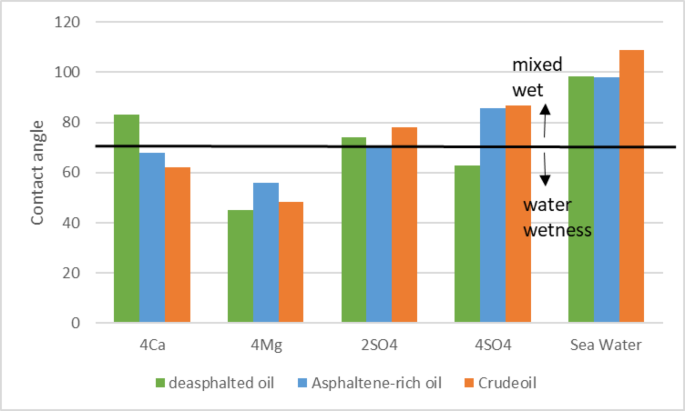
In the case of crude oil, injected seawater also shows oil-wet wettability. However, the best performance is observed with 4Mg brine, as illustrated in Fig. 3. This is further confirmed by contact angle measurements and recovery factor results, where 4Mg brine exhibits the lowest contact angle and the highest recovery factor, while seawater has the highest contact angle and the lowest recovery factor for systems containing crude oil.

Electrical double layer part of disjoining pressure for crude oil sample versus the brine samples.
For deasphalted oil, 4Mg brine also demonstrates the best performance similar to the crude oil case. The results align with the experimental data. For this oil sample, 2SO4 brine performs better than 4Ca brine, consistent with the experimental results discussed in the experimental section.
Effect of crude oil composition on wettability
To understand the effect of crude oil composition on wettability, the EDL component of the disjoining pressure for all 15 COBR systems is shown in Fig. 5. It is demonstrated that decreasing the asphaltene content of the oil sample makes EDL and disjoining pressure less negative, consequently. This indicates that asphaltene is a key factor contributing to the oil-wet nature of the system. furthermore, as demonstrated in Fig. 4, for deasphalted oil, 4SO4 brine performs better than 4Ca brine which is consistent with the experimental results (Fig. 5).

Electrical double layer part of disjoining pressure for deasphalted oil sample versus the brine samples.

Electrical double layer part of the disjoining pressure of the studied oil sample versus the brine samples.
link


.jpg "IFW Dresden selects Agnitron Agilis 100 MOCVD platform for precursor chemistry and ultra-wide-bandgap materials development")