
Characterization of the electronic structure and fate of doubly ionized carbon diselenide
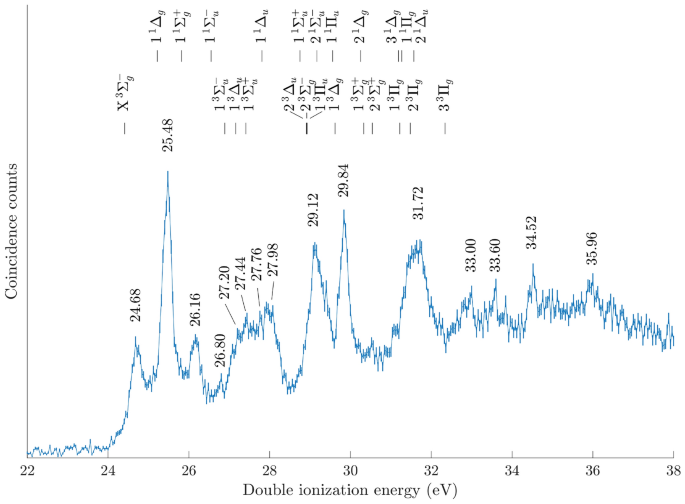
Figure 1 shows the double ionization valence electron pair spectrum of \(\text {CSe}_2\) obtained at the He II\(\alpha\) photon energy of 40.81 eV using the electron-only configuration of our multi-particle correlation spectrometer set-up described in the “Methods” section below. The spectrum has an onset of about 24 eV ionization energy, and contains sharp features at 24.68 eV, 25.48 eV, 26.16 eV, 29.12 eV, 29.84 eV and 31.72 eV, as well as several less distinct features between 26.5 and 28 eV, and above 32.0 eV ionization energy, respectively. The adiabatic ionization energy of \(\text {CSe}_2\) is computed as 24.16 eV at the MRCI/aug-cc-pVQZ-DK level. It corresponds to the onset of the first band in the spectrum of Fig. 1. The nominal resolution at these electron energies together with an uncertainty due to the procedure of calibrating the energy scale in absolute terms yield an uncertainty of the double ionization energy of ± 0.2 eV.

Valence double ionization electron spectrum of \(\text {CSe}_2\) obtained at the He II\(\alpha\) photon energy of 40.81 eV under electron-only conditions, reflecting several sharp features. Error bars represent the statistical uncertainty of the coincidence counts. Energy values given in the figure are based on the experimental results. For comparison, the theoretical vertical double ionization energies (VDIEs) are included as vertical lines.
Figure 2 shows complementary valence double ionization electron pair spectra of \({\hbox {CSe}}_{2}\) measured at the He II\(\alpha\) photon energy of 40.81 eV, where the more differential multi-electron-ion correlation set-up has been used to investigate the fate of doubly-ionized \({\hbox {CSe}}_{2}\) in respect to its ionic breakdown products. For comparison, the uppermost spectrum is the same as discussed in the context of Fig. 1, whereas the second spectrum from the top is based on three-fold coincidence events where all electron pairs were extracted in coincidence with the doubly-charged parent ion or the singly-charged cations \(\text {CSe}^+\), \(\text {Se}^+\), and \(\text {C}^{+}\) from dissociating \(\hbox {CSe}_2^{2+}\), respectively. As can be seen, the two spectra agree well, considering the difference in electron energy resolution for the electron-only and multi-electron-ion set-ups (see “Methods” section).

Valence double ionization electron spectra of \({\hbox {CSe}}_{2}\) obtained at the He II\(\alpha\) photon energy of 40.81 eV under electron-ion conditions, with the breakdown products of double ionization labelled accordingly. For some of the fragment spectra, the intensities have been scaled by a factor stated in the figure. Error bars represent the statistical uncertainty of the coincidence counts. The uppermost spectrum is the electron-only spectrum from Fig. 1.
The lower panels of Fig. 2 present electron pair spectra extracted in coincidence with the doubly-charged parent ion (using three-fold events) and with ion pairs (using four-fold events) labelled accordingly \(\text {CSe}^{+} + \text {Se}^{+}\), \(\text {Se}^{+} +\text { Se}^+\), and \(\text {Se}^{+} + \text {C}^+\), respectively. As can be seen, the first three lowest dicationic states starting at about 24.2 eV are primarily stable towards fragmentation. Starting at about 26.4 eV ionization energy, the formation of the \(\text {CSe}^{+} + \text {Se}^{+}\) pair sets in. From about 32.2 eV on, the \(\text {CSe}^{+} + \text {Se}^{+}\) channel competes with the formation of the ionic pair \(\text {Se}^{+} +\text { Se}^+\), and from about 35 eV on also with the \(\text {Se}^{+} + \text {C}^+\) fragmentation channel.
From the two-fold ion-ion coincidences it is possible to determine the kinetic energy release (KER) for the two most intense fragmentation channels. Estimates of the KER values are based on the FWHM width of the ion-ion coincidence peak and a computation of the electric field at the interaction point. The electrical field is estimated using a numerical replica of our setup in SIMION14, which provides the electrical field strength at different points in the interaction region. Since Se has several isotopes, the determination of the peak width is done by selecting the coincidence feature related to the most intense Se isotopes. For the \(\text {CSe}^{+} + \text {Se}^{+}\) channel the KER from the peak width is 3.2 ± 0.2 eV, when including all electronic states, and for the \(\text {Se}^{+} +\text { Se}^+\) channel the KER is 1.2 ± 0.2 eV.
To help the assignment of the features observed in Figs. 1 and 2, we performed ab initio computations on both the neutral and dicationic \({\hbox {CSe}}_{2}\) and its fragmentation channels. First, we optimized the geometry of the ground state of \({\hbox {CSe}}_{2}\) at the MRCI/aug-cc-pVQZ-DK and CCSD(T)/aug-cc-pVQZ-DK levels. Both computations lead to a centrosymmetric linear structure with a CSe distance of 1.70 Å, which agrees with the experimental value of 1.6919 Å, as determined by Bürger and Willner15. Also, the MRCI/aug-cc-pVQZ-DK harmonic frequencies of \(\omega _1\) = 1316 \(\hbox {cm}^{-1}\), \(\omega _2\) = 315 \(\hbox {cm}^{-1}\) and \(\omega _3\) = 375 \(\hbox {cm}^{-1}\) were computed. Assuming the reduction of these harmonic frequencies if taking into account the anharmonicity terms, we conclude to have a good agreement with the measured fundamentals (i.e. \(\nu _1\) = 1254.30 \(\hbox {cm}^{-1}\), \(\nu _2\) = 302.89 \(\hbox {cm}^{-1}\) and \(\nu _3\) = 374.48 \(\hbox {cm}^{-1})\) known in the literature15. This confirms the suitability of the MRCI/aug-cc-pVQZ-DK for studying the \({\hbox {CSe}}_{2}\) molecule and related neutral and ionic species, in particular for accounting for electron correlation and relativistic effects. Therefore, we started our computations dealing with \(\text {CSe}_2^{2+}\) by mapping its lowest singlet and triplet potential energy surfaces (PES) at the MRCI/aug-cc-pVQZ-DK level. Close to the Franck–Condon region assessed from the \({\hbox {CSe}}_{2}\) equilibrium, we located a minimum structure in the singlet PES and a minimum structure in the triplet PES. Both structures are centrosymmetric linear with the \(^3\Sigma _g^-\) and \(^1\Delta _g\) symmetry species with CSe distances of \(\sim\) 1.72 Å, slightly longer than that of neutral \(\text {CSe}_2\) (\(\hbox {X}^1\Sigma _g^+\)). They are obtained after removal of two electrons from the outermost \(\pi\) molecular orbital of \({\hbox {CSe}}_{2}\). This is associated with the weakening of the CSe bonds and results in low harmonic frequencies of (\(\omega _1\) = 710 \(\hbox {cm}^{-1}\), \(\omega _2\) = 224 \(\hbox {cm}^{-1}\), \(\omega _3\) = 346 \(\hbox {cm}^{-1}\), for \(^3\Sigma _g^-\), and \(\omega _1\) = 977 \(\hbox {cm}^{-1}\), \(\omega _2\) = 233 \(\hbox {cm}^{-1}\), \(\omega _3\) = 349 \(\hbox {cm}^{-1}\), for \(^1\Delta _g\)). The triplet is lower in energy, and thus corresponds to the ground state of \(\text {CSe}_2^{2+}\). These findings accord with the detection of \(\text {CSe}_2^{2+}\) in Fig. 2.
For the assignment of the bands in the electron-only spectrum shown in Fig. 1, we computed the vertical double ionization energies (VDIEs) of \(\text {CSe}_2^{2+}\) at the MRCI/aug-cc-pVQZ-DK level of theory. VDIEs are obtained as the differences between the energies of the dicationic electronic states and that of \(\text {CSe}_2\) (\(\hbox {X}^1\Sigma _g^+\)), where both molecular species are taken at the \(\text {CSe}_2\) (\(\hbox {X}^1\Sigma _g^+\)) equilibrium geometry. For direct comparison to the experimental spectrum shown in Fig. 1, the theoretical VDIEs are also included in this figure. We note the apparently good agreement between our experimental and theoretical data, with the \(\hbox {X}^3\Sigma _g^-\) state at 24.68 eV ionization energy reflecting the doubly-ionized ground state, which is followed by the dicationic 1\(^1\Delta _g\) and 1\(^1\Sigma _g^+\) states at 25.48 eV and 26.16 eV, and many more, to quite some extent, strongly overlapping excited electronic dicationic states. The energies and assignments of the first 8 states are summarized in Table 1, where assignment of experimental states between 27 and 28 eV is less certain since the peak structure is not apparent. For a more complete presentation of the theoretical VDIEs, the interested reader is referred to the Supplementary Table S1. The spacing of the experimental and theoretical states are in very good agreement with each other, and the offset between the theoretical and experimental energies of about 0.2 eV are within the resolution of the experimental data on the order of ± 0.2 eV.
Let’s concentrate now on the unimolecular fragmentation of \(\text {CSe}_2^{2+}\). For this purpose, we show in Fig. 3a one-dimensional cuts of the potential energy surfaces of \(\text {CSe}_2^{2+}\) states as a function of the CSe distance where the other CSe distance was fixed at 1.70 å, i.e. its value at the \({\hbox {CSe}}_{2}\)(\(\hbox {X}^1\Sigma ^+_g\)) equilibrium, together with dissociation limits for the \(\text {CSe}^{+} + \text {Se}^{+}\) channel. We also computed cuts where we lengthened both CSe distances symmetrically (Fig. 3b). These figures reveal several sufficiently deep potential wells, where (meta)stable \(\text {CSe}_2^{2+}\) can be found. The metastable states are separated from the corresponding dissociation limits by centrifugal type potential barriers. Similarly, potential energy surface cuts (PECs) for bending the molecule with both CSe distances kept fixed at 1.70 å are given in Fig. 4. This figure shows that most electronic states of this dication possess minima for linear structures. Additional local minima can be seen for bent configurations due to avoided crossings (e.g. between the two lowest \(^3A_2\) components). All doubly degenerate states split into two components for bent configurations due to the Renner–Teller effect. Avoided crossings can be observed for collinear configurations. Altogether, we found a high density of electronic states that favours inter-state interactions by vibronic (e.g. at their avoided crossings), spin-orbit (at the crossing between states with different spin multiplicities) and Renner–Teller (for doubly degenerate states) interactions. Consequently, the unimolecular decomposition processes are expected to be very complex, involving multiple steps. The high density of electronic states and the strength of the interactions may even be sufficient to permit a statistical description of the dissociations, such as that embodied in the recent “\(\hbox {M}_3\)C” computational approach16.

Adiabatic potential energy curves of \(\text {CSe}_2^{2+}\) for (a) states along the CSe distance whereas the other CSe distance is fixed at 1.70 å, i.e. its value at the \({\hbox {CSe}}_{2}\)(\(\hbox {X}^1\Sigma _g^+\)) equilibrium, and (b) lengthening both CSe distances symmetrically for linear configurations. In both panel (a) and (b), the reference energy is that of the \({\hbox {CSe}}_{2}\)(\(\hbox {X}^1\Sigma _g^+\)) state at equilibrium, and FC indicates the middle of the Franck–Condon zone relative to the \({\hbox {CSe}}_{2}\)(\(\hbox {X}^1\Sigma _g^+\)) state. Dissociation limits were computed at the RCCSD(T)/AUG-CC-PVQZ-DK level and by using values from NIST for atomic excitation energies. Note the different energy scales on the vertical axes.

Adiabatic potential energy curves of \(\text {CSe}_2^{2+}\) along the in-plane angle \(\theta\), where both CSe distances are fixed at 1.70 å, i.e. their value at the \({\hbox {CSe}}_{2}\)(\(\hbox {X}^1\Sigma _g^+\)) equilibrium. The reference energy is also that of \({\hbox {CSe}}_{2}\)(\(\hbox {X}^1\Sigma _g^+\)) at the same equilibrium. For assignment of the states for bent structures, the molecule is put in the yz-plane. While all states are linear, isomerization may occur on the 1 \(^1\Sigma _u^-\) or 1 \(^3\Sigma _u^-\) potential energy curves for energies > 29.5 eV.
In the 22–40 eV photon energy range, we located several dissociation limits for \(\text {CSe}_2^{2+}\). At the (R)CCSD(T)/aug-cc-pVQZ-DK level, the lowest charge separation channel \(\text {CSe}^+\)(\(\hbox {X}^2\Sigma ^+\)) + \(\text {Se}^{+}\)(\(^4\)S) is computed at 24.10 eV with respect to the \({\hbox {CSe}}_{2}\)(\(\hbox {X}^1\Sigma ^+_g\)) minimum energy and after considering Zero Point vibrational Energy (ZPE) corrections. The charge retaining channel (forming \(\text {CSe}^{2+}\)(\(\hbox {X}^3\Pi\)) + Se (\(^3\)P) is computed at 34.53 eV. Surprisingly, the lowest Coulomb explosion channels producing \(\hbox {Se}^+\) (\(^4\)S) + \(\hbox {Se}^+\)(\(^4\)S) + C(\(^3\)P) or \(\hbox {Se}^+\) (\(^4\)S) + Se(\(^3\)) + \(\hbox {C}^+\)(\(^2\)P) are lying at relatively low energies (at 28.92 eV and 30.59 eV, respectively), and thus distinctly lower than the charge retaining channel.
We calculated a relatively low thermochemical threshold for the \({\hbox {CSe}}_{2}\) \(\rightarrow \hbox {Se}_2^+\)(\(\hbox {X}^2\Pi _g\)) + \(\hbox {C}^+\)(\(^2\)P) dissociation of 26.53 eV. We note that this channel requires bond rearrangement of \(\text {CSe}_2^{2+}\) from linear to bent structures. Figure 4 shows that such arrangements cannot occur for energies below 27.5 eV since one needs to populate at least the bent minimum of the 1\(^1\Sigma ^-_u\) or of the 1\(^3\Sigma ^-_u\) state or of those of the upper states. Indeed, the three lowest electronic states of this dication possess unique minima for linear configurations.
As can be seen from Fig. 3a, theory suggests 26.8 eV as the appearance energy (AE) for the \(\text {CSe}^{+} + \text {Se}^{+}\) channel, corresponding to the top of the potential barrier of \(\text {CSe}_2^{2+}\)(\(\hbox {X}^3\Sigma _g^-\)). This computed AE is in line with our experimental observations of the appearance of these products at 26.4 eV. The yield of \(\text {CSe}^{+} + \text {Se}^{+}\) continues to dominate the dissociations up to at least 30 eV double ionization energy (DIE) where the spectrum has two more distinct features, one broad peak at around 29.2 and one peak at 31.5 eV. Since these peaks overlap, the AEs for the underlying processes are likely to be somewhat lower than the visible onsets in the spectrum, 28.2 and 30.5 eV, respectively. From the better resolved uppermost electron-only spectrum in Fig. 2 it is evident that at least the first feature consists of several peaks. To identify the internal energies (i.e. electronic and/or vibrational states) of the fragments from dissociation at the DIEs of these two features, experimental AE and KER can be compared with the theoretical results. Several different fragmentation channels are possible according to the PECs and dissociation limits presented in Fig. 3a. Experimental KER values can be estimated from the FWHM of the corresponding ion peaks, a method which may slightly underestimate the actual KERs17. Determining the KER separately for the three DIE peaks in the \(\text {CSe}^{+} + \text {Se}^{+}\) channel requires four-fold coincidences, and selection on ideally a single Se isotope. This significantly reduces the statistics, making KER determination rather difficult, but from the widths of the ion peaks it is evident that the KER increases for higher DIE. The difference in KER implied from the peak width difference is about 1 eV over the range of DIE from 26.4 to 32.0 eV. A global estimate of the KER from two-fold ion-ion coincidences is 3.2 ± 0.2 eV, arising from all electronic states in the \(\text {CSe}^{+} + \text {Se}^{+}\) channel excited at 40.81 eV. This value probably reflects a mean or a dominant contribution, but because the peak width depends on the square root of the energy release, a wide distribution of KERs is not excluded. We also note that the theoretical KERs exclude any vibrational excitation in the \(\hbox {CSe}^+\) fragment and so are upper limits. For instance, closer inspection of Fig. 3b, which show PECs for the lengthening of the C-Se distance, suggests that the vibrational excitation energy of \(\text {CSe}^+\) could be several eV high before dissociation of the diatomic. Some internal vibrational energy for the \(\text {CSe}^+\) fragment is reasonable, since the removal of two electrons from \(\pi _\text {u}\) probably will lengthen both CSe bonds. This may result in a longer bond for the \(\text {CSe}^+\) fragment compared to its vibrational ground state, and so it becomes vibrationally excited.
Comparison of experimental KER and AE to the possible fragmentation channels in Fig. 3a, allows us to identify the final state of the first DIE peak as \(\text {CSe}^+\) (\(\hbox {X}^2\Sigma ^+\)) + Se+ (\(^4\)S), with theoretically predicted AE of 26.80 eV and a KER of 2.70 eV. Here, it is clear that fragmentation takes place on the dicationic ground state potential which correlates to the \(\text {CSe}^+\) (\(\hbox {X}^2\Sigma ^+\)) + Se+ (\(^4\)S) dissociation limit. The second theoretical AE of 28.60 eV corresponds to a multi-step process, where we populate first the \(\text {CSe}_2^{2+}\) electronic states located in the 26.8–28.8 eV energy range, that convert later by spin-orbit interaction to the long range repulsive part of 1\(^5\Sigma ^-_g\) (leading to \(\text {CSe}^+\) (\(\hbox {X}^2\Sigma ^+\)) + Se+ (\(^4\)S) with a KER of ca. 4.5 eV) or to that of 1\(^3\Pi _u\) /1\(^5\Pi _g\) (leading to \(\hbox {CSe}^+\) \((A^2\Pi\)) + \(\hbox {Se}^+\)(\(^4\)S) with a KER of ca. 3.4 eV). The higher theoretical KER is quite far from the measured mean value and, as mentioned before, we cannot exclude any vibrational excitation in, for instance, the ground state of the \(\hbox {CSe}^+\) fragment. Furthermore, we cannot exclude the possibility that \(\hbox {CSe}^+\) by this process is formed in the A-state instead of the X-state. For energies > 29.2 eV, a third mechanism is possible, which would lead to the first dissociation limit via 1\(^5\Sigma ^-_g\), the second dissociation limit via 1\(^3\Pi _u\) /1\(^5\Pi _g\) or to the third dissociation limit (i.e. \(\hbox {CSe}^+\) (\(\hbox {X}^2\Sigma ^+\)) + Se+ (\(^2\)D)). Closer inspection reveals that the two first pathways are associated with large KERs while only the third one has a theoretical KER of about 3.5 eV close to the experimental mean value. This suggests that the \(\hbox {Se}^+\) ions may be produced in the \(^2\)D state and not the ground \(^4\)S state. The production of such electronically excited fragments is not surprising in dissociation of a triatomic molecule, where the overall density of states can hardly be sufficient to enforce statistical equilibrium.
Figure 3b shows MRCI/aug-cc-pVQZ-DK potential energy curves of \(\text {CSe}_2^{2+}\) states while lengthening both CSe distances symmetrically for linear configurations, together with dissociation limits of the \({\hbox {Se}^{+} + \hbox {C}^{+} + \hbox {Se}}\) and \({\hbox {Se}^{+} + \hbox {Se}^{+} + \hbox {C}}\) channels, where the reference energy is that of the \({\hbox {CSe}}_{2}\)(\(\hbox {X}^1\Sigma ^+_g\)) state at equilibrium, and FC marks the middle of the Franck–Condon zone relative to the \({\hbox {CSe}}_{2}\)(\(\hbox {X}^1\Sigma ^+_g\)) state. The experimental findings show an AE for the \(\text {Se}^{+} +\text { Se}^+\) channel of 32.2 eV, with a KER of 1.2 eV estimated from the ion-ion peak width, while from theory, the AE lies between 31-32 eV, with a calculated KER of 1-2 eV; the uncertainty of these two calculated values is due to the presence of many different states that may contribute. With somewhat higher AE, above 34 eV, the \({\hbox {C}}^{+} + \hbox {Se}^{+}\) fragmentation channel overlaps with the \(\text {Se}^{+} +\text { Se}^+\) channel at high DIE. This higher AE is probable for the \(\text {C}^{+} + \hbox {Se}^{+}\) channel, since the ionization potential for C is higher than Se, while theory predicts 30.6 eV. As a result of the numerous states involved, it is difficult to determine more specifically the path of this dissociation.
An important observation in the ion-ion coincidence map of doubly-ionized \({\hbox {CSe}}_{2}\) is that the slope for the coincidence island of \(\text {Se}^{+} + \text {C}^+\) channel is very steep, about −4 ± 1, showing that the \(\hbox {C}^+\) ion is a secondary product from sequential decay of \(\hbox {CSe}^+\). In contrast, the \(\text {Se}^{+} +\text { Se}^+\) island has a slope equal to \(-1\), suggesting a simple, possibly instantaneous explosion of the original symmetrical dication. If the sequential decay of \(\hbox {CSe}^+\) takes place after completely leaving the Coulomb zone and losing all initial angular alignment relative to the \(\hbox {Se}^+\) ion, the slope of the island would be \(-7.7\) (from linear momentum conservation and the masses of the fragments). The experimental slope shows that the sequential reaction is \({\text {CSe}_{2}^{2+} \rightarrow \hbox {Se}^{+} + \hbox {CSe}^{+} \rightarrow \text {Se}^{+} + \hbox {C}^{+} + \text {Se}}\), and not secondary decay of \(\hbox {Se}_2^+\) as in that (unlikely) case the slope would be \(-0.5\).
We note that from a thermodynamical point of view and according to our theoretical investigations, the exotic double ionization channel \(\text {CSe}_2\) (\(\hbox {X}^1\Sigma ^+_g\)) \(\rightarrow\) \(\hbox {Se}_2^+\) (X \(^2\Pi _g\)) + \(\hbox {C}^+\) (\(^2\)P) is expected to be energetically accessible from 26.53 eV + some KER, while no experimental evidence for this channel was found within the energy range investigated. By having a closer look at the PECs shown in Fig. 4, it is reasonable to say that all the states are linear in the Franck–Condon region accessible from the \({\hbox {CSe}}_{2}\) (\(\hbox {X}^1\Sigma ^+_g\)) state, which implies that, upon double ionization, bending or isomerisation to form \(\hbox {Se}_2^+\) is unlikely to occur. Furthermore, a possible explanation for not observing the formation of \(\text {Se}_2^+\) from double ionization could be that Coulomb explosion of \(\text {CSe}_2^{2+}\) takes place already at an unusually low energy, while for other analogue systems the dimer production is observed instead. This is especially the case of inner-shell ionization of \({\hbox {CO}}_{2}\) and of valence double ionization of \(\text {SO}_2\), for which the channel producing \(\text {O}_2^+\) has been reported in the literature3,18,19, although studies on the other analogous system, \({\hbox {CS}}_{2}\) by Lablanquie et al.20 does not suggest the production of the \(\text {S}_2^+\) dimer. Apart from that, no metastable \(\text {CSe}_2^{2+}\) has been detected, while metastable \(\text {CS}_2^{2+}\) and \(\text {CO}_2^{2+}\) species are known in the literature20,21.
The charge retaining double ionization channel \(\text {CSe}_2\) (\(^1\Sigma ^+_g\)) \(->\) \(\hbox {CSe}^{2+}\) (X \(^3\Pi\)) + Se(\(^3\)P) is predicted by our calculations to occur at 34.53 eV and onwards. Although seen in the ion spectra, from the present multi-dimensional data sets, this channel is statistically not sufficiently significant to deduce any AE or DIE values. We believe that the weak observation of the charge retaining channel, although it is thermodynamically allowed, is due to the presence of low lying states leading to Coulombic explosion.
link



.jpg "IFW Dresden selects Agnitron Agilis 100 MOCVD platform for precursor chemistry and ultra-wide-bandgap materials development")