Cate Hawting: A Summer of (Crystal) Growth
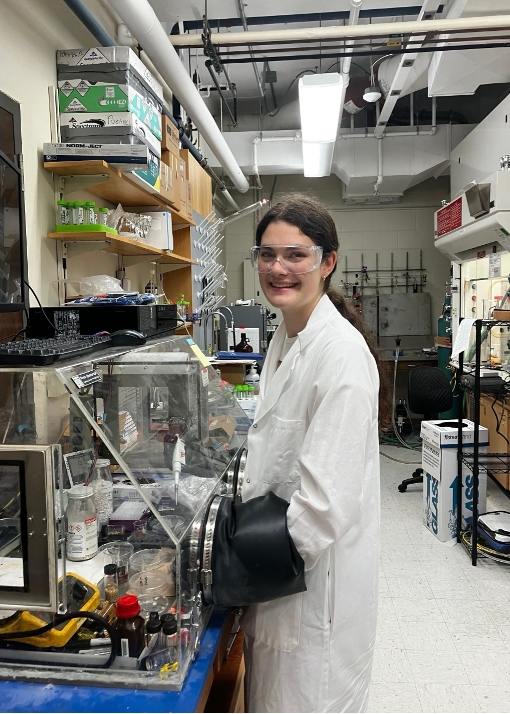
Looking around the lobby of Engineering Hall that rainy Thursday morning, something took me back to elementary school. Maybe it was the plunge into an unfamiliar place, or maybe just the first day nerves. Either way, as we stood in that shiny new building nervously waiting to be picked up by our graduate student mentors, it felt like a new beginning.
For me, it certainly was. I would be spending the summer doing chemistry research at the University of Wisconsin-Madison and had been matched with Dr. Song Jin’s lab, a materials chemistry group. I would specifically be working in the perovskite subgroup under Kristel Forlano, a graduate student entering her sixth year. Her PhD research is focused on creating heterostructures, or stacking layers of materials together, combining lead and tin perovskites. Perovskites are a group of materials which are particularly exciting to the solar energy industry because they are a potential competitor to silicon, the semiconductor material of choice in current solar cells. My goal for the summer was to grow 2D tin perovskites using a method known as confined growth. This was a particular challenge because while people have reported using confined growth for 3D tin and 2D lead perovskites, confined growth of 2D tin is largely undeveloped. Though I can explain much of the terminology and background now, back in May when I first got word of my pairing I was mildly panicked. I became interested in chemistry a bit later in my undergraduate journey and thus had yet to take analytical, inorganic, or physical chemistry, all of which were highly relevant to the work of Dr. Jin’s group.
This meant I was entering my research experience feeling unsure of myself and nervous about revealing how much I didn’t know. The self-doubt lessened a bit after talking with some other students in my program who were in similar positions, but what helped the most was seeing some of the same sentiments in grad students. One of the most beneficial parts of my summer was getting to witness accomplished grad students openly being unsure and asking for help. It gave me some reassurance in the short term, but also changed my view of “who goes to grad school.”
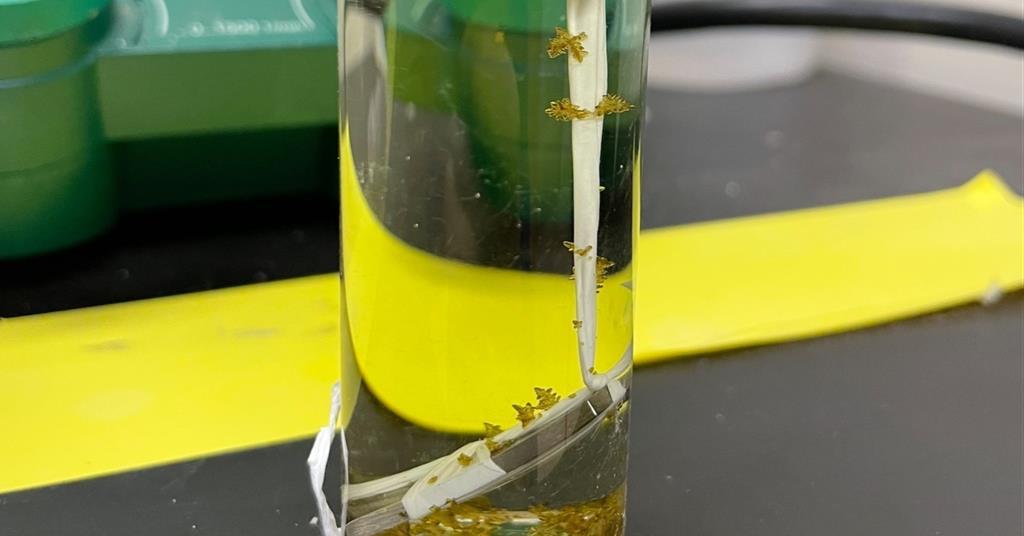
This spirit of perseverance was particularly important during the first half of my research experience as Kristel and I were trying to identify a successful confined growth procedure. She showed me a method that had previously given her promising results, but no matter how much I tried it, no good crystals would grow. I then went to the literature, searching through paper after paper, when I came across an idea that excited me: “seed crystal coating”. My grad student approved the experiment, we borrowed the necessary equipment from a neighboring lab, and got to work. Once again, regardless of the variables we tweaked, good crystals just did not want to grow. Feeling slightly defeated, I returned to the literature once more and struck gold with one of the original papers published on confined growth. Cautiously optimistic, I ran my first trial and was thrilled to see beautiful, shiny crystal plates looking back at me.

Throughout the rest of the summer, my typical weekly tasks included synthesizing single crystals, setting up various confined growth experiments, and testing washing solutions as well as analyzing samples using the optical microscope and scanning electron microscope (SEM). In the office, I usually spent my time keeping track of experimental details and results in my digital records, making observations and brainstorming as results came in, and reading and taking notes on relevant papers. I would also attend weekly group meetings to hear presentations from around the lab and typically check in with my grad student mentor each morning about my tasks and our general objectives for the coming days.
There was a lot I enjoyed about the research I conducted in the Jin Group. I appreciated the freedom to test things as I saw fit, a contrast to labs I’d worked in previously where precisely following procedures was more heavily emphasized. I found the feeling of creating something new, of working on a problem nobody has yet solved, to be deeply motivating. I also loved being in a very collaborative environment where I could lean on others for help and learn from them about other chemistry niches. I definitely found that the beginning of my research experience was the most challenging period. Working on the same project for eight hours a day was an adjustment from my usual undergraduate days which involve jumping from class to study session to meeting and back again. From an academic standpoint, in the beginning it was difficult to be given a topic I knew very little about and have to start generating ideas to improve it soon after. While this got better and better as the weeks passed, it could be frustrating to start out feeling like I was in the dark.

Moving forward, this experience has reinforced my ambitions to go to graduate school and conduct chemistry research applicable to sustainability challenges. Afterwards, I’d like to pursue a career applying chemistry research to environmental issues, likely in the world of academia.
In conclusion, this summer I learned a lot about myself in a research context. I reaffirmed that I like feeling challenged, despite how overwhelming it may be in the beginning. I also learned that I work best in an environment where collaboration and asking for help is encouraged. Perhaps most importantly, I was able to broaden my idea of “who goes to grad school.” Pursuing a Ph.D. isn’t just for prodigies – it’s for people who are passionate and willing to grow, for people who want to better themselves, their field, and our understanding of the world.
link

.jpg "IFW Dresden selects Agnitron Agilis 100 MOCVD platform for precursor chemistry and ultra-wide-bandgap materials development")
