


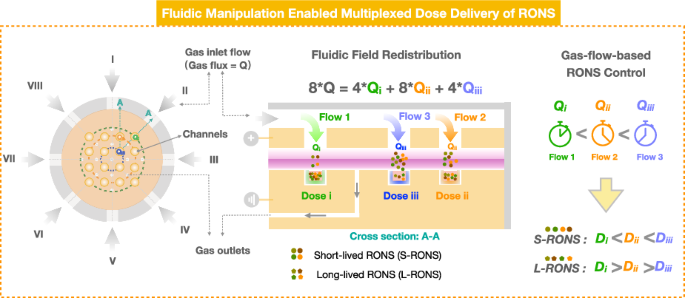
Manipulate fluidic field to produce velocity-diverse gas streams for multiplexed dose delivery
Three dimensions of the gas flow model were established and calculated in the COMSOL Multiphysics (version 6.0) platform to simulate the transformation of the fluidic field for producing velocity-varied gas streams. A quarter model was selected to simplify calculations (Fig. 2a). Feed gases enter the device through gas inlets and disperse via transport channels categorized into Group 1 (green channels), Group 2 (yellow channels), and Group 3 (blue channels) (Fig. 2a). Upon injection, the feed gases diffuse along the injection axis and subsequently spread across the entire space (Figs. 2b and S1 and Movie 1). Gas diffusion velocities decrease with the increment of the diffusion distance24. Initially, distance-dependent diffusion causes a greater accumulation of gases above Group 1 channels, followed sequentially by Group 2 and Group 3 channels (Fig. S2). However, Group 2 channels can capture adjacent two injected gas streams, whereas Group 1 and Group 3 channels can only capture one gas stream that originates from gas inlets II, IV, VI, and VIII (Fig. S3). As diffusion distance increases, overlay diffusion surpasses distance-dependent diffusion and dominates gas distribution. Correspondingly, Group 2 channels witness the highest gas flow velocity at the entrance of the transport channel (Fig. 2c-i).


a Schematic design and allocation of the gas inlets and transport channels in the device. b Overview of simulation results depicting gas diffusion in the device. c Simulation of gas distribution in the transport channels. (i Profiles of gas flow at the channel entrance; ii Profiles of gas flow at the channel exit; iii Plot of average gas velocities within the transport channels). d Plot of gas flux in the transport channels. e Evolution of gas flux at the channels exits as a function of increasing gas injection flux. f Nitrite generation in PBS when samples are loaded in three dose circles and treated with varying feed gas injection fluxes
To enter the transport channels, the feed gas converges into high-speed narrow streams. Due to variations in gas entering velocity and angle, the reproduced three groups of gas streams exhibit distinct distribution topography in the cross-section: Group 1 streams occupy the lower-left quadrant, Group 2 streams occupy either the lower-right or upper-left quadrant, and Group 3 streams nearly fill the entire channel (Fig. S4). After entering the transport channels, the suddenly enlarged space decelerates the gas flows (Fig. 2c-ii). Since Group 3 streams maintain a diameter similar to that of the channel, their flow velocity is less reduced and becomes the highest at the channel exit, followed by Group 2 and then Group 1 channels (Fig. 2c-iii). At a distance of 0.5 mm from the channel exit, gas flow velocities experience a significant increase due to a 2 mm reduction in channel diameter, necessary for inserting the dielectric barrier sheet to prevent arc discharge. Within the discharge slit, gas streams start to move from the transport channels to the exhaust vents while maintaining the formed gas velocity gradient (Fig. S5). Besides, the fluidic field is resistant to the device dimension variations (Fig. S6). Provided the height of transport channels is larger than 3.5 mm, the fluidic field remains stable, indicating good tolerance towards machining and assembly errors.
When feed gases are injected into the device at a flow flux of Q = 6 L/min, the flow fluxes at the channel exit are 234.6 mL/min (0.04Q) for Group 1 channels, 350.4 mL/min (0.06Q) for Group 2 channels, and 475.8 mL/min (0.08Q) for Group 3 channels (Fig. 2d). Theoretically, the excited plasma chemistry can be associated with gas flow velocities26. The differentiated flow flux at the channel exit predicts that the fluidic field can be programmed by redistributing the injected gases to excite chemistry-diverse plasmas. Moreover, varying the feed gas injection flux could further modulate these flow flux differentials: higher injection fluxes lead to more pronounced differences (Fig. 2e). As aforementioned, plasma treatment dose can be presumably evaluated based on the synergy of the generated reactive species, electromagnetic waves, and ultraviolet radiation. However, accurately quantifying these reactive species poses challenges in defining treatment doses based on clear plasma chemistry. Nitrite is a typical plasma-produced long-lived species and can be easily quantified27, thus here we consider it as a potential indicator to imply the dose discrepancy. For instance, when gas injection flux exceeds 3 L/min, a 1-min plasma treatment can result in 3 concentrations of the nitrite in 100 µL PBS (Fig. 2f). Consequently, the 3 groups of gas streams capably produce chemistry-diverse plasmas for multiplexed dose delivery.
Demonstration of plasma-vulnerability evaluation and dose optimization by multiplexed dose treatment on cancer cells and bacteria
Selective-killing tumor cells represents the most attractive biomedical application of CAP28,29. Although radiotherapy and chemotherapy can be employed to fight cancer, their indiscriminate killing of healthy and cancerous cells causes severe adverse effects harming the patient’s body30,31. In contrast, CAP can preferentially kill tumor cells by destroying redox homeostasis, without giving rise to side effects or inducing any drug resistance32,33. When employed adjunctively, CAP can even re-sensitize the resistant cells to chemotherapy34,35. Additionally, CAP can effectively eradicate bacteria, enabling the treatment of bacteria-infected disease36,37. Clinically, broad-spectrum antibiotics are predominantly used to treat keratitis38, periodontitis39, and infected wounds40. However, excessive antibiotic use can promote drug-resistant bacteria strains, leading to treatment failures and exacerbating infections41. In contrast, CAP eliminates bacteria by the synergistic action of plasma-produced reactive oxygen and nitrogen species, which are less likely to induce drug resistance37. Moreover, CAP can enhance therapeutic effects by promoting cell proliferation for wound healing42,43,44. Since different cancer cells and bacteria strains exhibit varying susceptibility to plasma treatment45, CAP-based therapy is particularly effective against plasma-vulnerable cancers and bacteria-induced disease, with optimal treatment doses tailored to achieve therapeutic effects. Here we radiate four types of cancer cell lines (A549, SCC-15, Huh7, HepG2) and four strains of bacteria (S. aureus, MRSA, P. aeruginosa, MDRPA) with our prototype device to analyze their susceptibility to CAP and explore the optimal dose.
Different samples were loaded onto the same dose circle to screen for the more sensitive cancer type, whereas the same samples were placed on different dose circles to optimize the treatment dose (Fig. 3a). Following this sample loading pattern, five experiment cycles will be sufficient to identify the most vulnerable cancer type or bacteria strain and determine the applicable treatment dose, which is more than five times faster than with traditional plasma jet devices (27 experiment cycles required) (Fig. 3b). Since low feeding gas flux cannot effectively distinguish the three doses (Fig. 2f), the gas injection flux of Q = 4 L/min was selected to ignite the chemistry-various plasmas for multiplexed dose delivery. As no standard or universally accepted dose definition has been established yet, we follow the routines of characterizing the dose based on plasma-ignition input parameters in our confirmatory experiments (Table 1). Cell suspensions are transferred to pre-sterilized glass receptacles for plasma exposure, followed by a 24-h incubation in 6-well plates for subsequent analysis (Fig. 3c).


a Schematic illustrating the loading pattern of the treated cancer cells and bacteria samples. b Experimental plan of the CAP vulnerability test and dose optimization using the demonstration device. c Experimental procedures for plasma exposure to the cancer cells and bacteria. d Cell proliferation after plasma treatment for 1 min in the dose-iii-circle. e Cell proliferation of the liver cancer cell line Huh7 following 1 min of plasma treatment. Cell suspension (2 × 10⁵ cells/100 µL PBS) was transferred into pre-sterilized glass receptacles before plasma treatment. Following treatment at an input power of 70 W, cells were incubated for 24 h before analysis. Control samples were exposed to feed gas alone for the same duration without plasma excitation. Data are presented as mean ± SD. Experiments were conducted in triplicate and repeated four times. Statistical significance was determined using one-ANOVA test for multiple comparisons. ****p < 0.0001
The Huh7 liver cancer cell line demonstrates high sensitivity to CAP with a proliferation rate of 27.6% after 1-min treatment, followed by the SCC-15 tongue cancer cell line at 43.58%, and the A549 lung cancer cell line at 69.36% (Fig. 3d). In contrast, the HepG2 cell line exhibits relative resistance to CAP, showing a significantly increased proliferation rate of 117.9%. CAP treatment results in clear cell shrinkage and detachment of A549, Huh7, and SCC-15 cells (Fig. S7). When considering different doses, dose iii treatment results in a proliferation rate of 27.5% for Huh7 cells, followed by dose ii (38.6%), and dose i (58%) (Figs. 3e and S8). Clearly, the Huh7 cell line is the most vulnerable to CAP and appears promising for plasma-based cancer therapy among the tested four cell lines. Evaluating treatment doses based on cell proliferation rates and following a clinical dose evaluation standard akin to a 50% lethal rate46, dose iii emerges as the most suitable. In terms of bacterial treatment, 1-min plasma exposure kills 100% of P. aeruginosa and MDRPA, while S. aureus and MRSA show varying degrees of resistance to CAP, with a proliferation rate of 22.9% and 70.3%, respectively (Fig. 4a, b). Among the doses tested, dose iii results in a proliferation rate of 22.9% for S. aureus, followed by 35.5% for dose ii, and 66.5% for dose i (Fig. 4c). These findings indicate that P. aeruginosa and MDRPA are highly susceptible to plasma treatment, making them suitable targets for CAP-based bactericidal therapy. Meanwhile, CAP-based therapy shows promise for treating S. aureus infections, as 1-min radiation (dose iii) achieves a proliferation rate of 22.9%, with proliferation rates between dose i and dose ii approaching 50%.


a Viability of S. aureus, MRSA, P. aeruginosa, and MDRPA following CAP treatment. Samples were prepared by diluting the original bacteria culture media in PBS to form a 106 CFU/mL suspension. 100 µL of sample was transferred to glass receptacles and treated with CAP for 1 min at an input power of 70 W within the dose iii circle. b Remaining colony-forming units of the bacteria post-CAP treatment. c Viability and remaining colony forming units of S. aureus after CAP treatment. S. aureus suspension (106 CFU/mL) were simultaneously loaded into the three dose circles and subjected to CAP treatment for 1 min at an input power of 70 W. d Viability of S. aureus biofilm following CAP treatment. A 100 µL sample of S. aureus suspension (108 CFU/mL) was placed in the dose iii circle and exposed to CAP for 1, 3, and 5 min at an input power of 70 W. Treated samples were incubated for 48 h and stained with crystal violate to assess biofilm growth. e SEM image of S. aureus biofilm. A 100 µL S. aureus suspension (108 CFU/mL) was incubated on the coverslips for 24 h to form the biofilm. The biofilm was then treated with CAP for 1 min at an input power of 70 W within the dose iii circle. f Lived-dead assay of S. aureus biofilm pose-plasma treatment. A 100 µL S. aureus suspension (108 CFU/mL) was incubated in glass receptacles for 24 h to form the biofilm. The biofilm was exposed to CAP for 5 min at an input power of 70 W within the dose iii circle. Data are presented as mean ± SD. Experiments were conducted in triplicate and repeated two or three times. Statistical significance was determined using either one-way ANOVA test or t test for multiple comparisons. ****P < 0.0001
When the potentially effective dose outranges the current set 3-level doses (1 min/70 W), we have options to increase the input power or extend the treatment duration (conventional dose modulation approach) to elevate overall dose levels and synergy with multiplexed treatment for dose optimization. Biofilms, which shield encapsulated bacteria from plasma-produced reactive species, require a higher 50% lethal CAP dose for eradication compared to planktonic bacteria47. To demonstrate the traditional dose optimization, S. aureus biofilm was exposed to plasma for 1 min, 3 min, and 5 min on the dose iii circle. The violate-staining reveals biofilm growth reductions of 20% with 1-min treatment, 28.6% with 3-min treatment, and 63.3% with 5-min treatment (Fig. 4d). Brief treatments (1 min) reduce biofilm coverage, causing bacteria shrinkage and fragmentation (Fig. 4e), while longer treatments (5 min) lead to over 90% bacteria death (Fig. 4f). The treatment duration for achieving a 50% proliferation dose in S. aureus biofilm is estimated to be around 4 min (Fig. S9). Precise treatment doses can be determined by placing samples on the three-dose circles and exposing them to plasma for 4 min. This flexible combination of innovative multiplexed dose treatment and traditional dose modulation facilitates dose optimization tasks. Multiplexed dose treatment enables efficient testing of target cell lines and bacteria strains for CAP susceptibility and facilitates optimizing appliable treatment doses, advancing the clinical application of CAP-based therapies. The distinct growth inhibition and eradication effects observed with CAP treatment indicate that different dose regimens can induce varying biological responses, exerting different levels of pressure on the samples. Multiplexed dose treatment aids in effectively analyzing sample responses under diverse dose conditions, enhancing understanding of the CAP anti-cancer mechanisms.
Gas flow velocity plays dual roles in producing RONS for cancerous cells eradication
The anti-cancer and bactericidal effects of CAP can be attributed to the produced reactive oxygen (O, O2−, 1O2, OH*, O3, H2O2) and nitrogen species (NO, NO2−, NO3−, OONO−)48. Due to the high reactivity, the short-lived species (O, O2−, 1O2, OH*, O3, NO, OONO−) can only diffuse over a limited distance, often failing to reach the target samples. Consequently, the responses of treated bio-samples are dominated by long-lived species such as NO2−, NO3−, and H2O249. Given that our samples are suspended in PBS, the short-lived species are likely neutralized by the liquid barrier, leaving the long-lived species primarily responsible for cell eradication. Thus, theoretically, cell suppression should increase with higher levels of NO2−/NO3 and H2O2 generation50. However, in our experiment, a higher concentration of NO2− does not aggravate cell suppression; instead, it results in a relatively higher rate of cell proliferation. For instance, 1.5-min plasma treatment of 100 µL PBS yielded 150 µM NO2− for samples placed in dose i circle, 95 µM for dose ii, and 69 µM for dose iii (Fig. 5a). In contrast, under the same plasma treatment conditions, the A549 lung cancer cells suspended in 100 µL PBS exhibited a proliferation rate of 85% for dose i, 60% for dose ii, and 56% for dose iii (Fig. 5b). This result suggests that the long-lived species of NO2−/NO3 and H2O2, are not the main contributors to inhibiting cell growth. When the short-lived species are removed by treating the cells with plasma-activated PBS, the cell proliferation rates across the three-dose circles approximate the same value of 90% (Fig. 5c). Consequently, we hypothesize that the unexpected cell growth inhibition (with a dose-dependent trend: dose i > dose ii > dose iii) is attributed to the short-lived species.


a Generation of Long-lived species in 100 µL PBS following plasma treatment for 1.5 min at an input power of 70 W. b Proliferation of the lung cancer cells (A549) after plasma treatment for 1.5 min. c Proliferation of lung cancer cells treated with plasma-activated PBS (The PBS was exposed to plasma for 1.5 min). d Generation of short-lived species with increased feed gas injection speed. e Generation of long-lived species with increased feed gas injection speed. f Cell proliferation rate as a function of increased feed gas injection speeds. g Schematic illustrating the dule roles of gas flow velocity in producing long-lived and short-lived species. Data were presented as mean ± SD. All experiments were conducted in triplicate and repeated three or four times. Statistical significance was determined using either a t test or a one-way ANOVA. *P < 0.05, **P < 0.005, ***P < 0.0005, ****P < 0.0001
To substantiate this hypothesis, we conduct comparative tests to exclude other potential factors. The cell proliferation rates of both control and experimental groups remained consistent when cells were treated with blowing gas without CAP ignition (Fig. S10A). A 1-min CAP treatment only evaporated 2.25% suspension (2.25 µL), leaving sufficient PBS (97.75 µL) to suspend and protect the cells (Fig. S10B). The pH value remained around 7.2, indicating that CAP treatment did not acidify the cell suspension to suppress cell growth (Fig. S10C). When cells were shielded with a shelter (Fig. S10D) to block reactive species, allowing only the transmission of UV & electromagnetic waves (UV-transmissible quartz shelter) or solely electromagnetic waves (UV-opaque glass shelter), the CAP treatment resulted in a comparative cell proliferation rate to the control group (Fig. S10E). Cell growth inhibition was not observed when cells were treated with a parallel-electrode-established uniformly distributed electric field (Fig. S11A) without plasma excitation (Fig. S11B). These results support the hypothesis that short-lived species play a crucial role by excluding the functions of gas blowing, evaporation, acidification, electromagnetic waves, UV, and electrical fields in suppressing cell growth.
According to the design concept, the different gas flow velocities are exclusively exploited to distinguish plasma treatment doses. In principle, the gas flow velocity can influence both the plasma ionization coefficient and the interaction between the produced species and the sample51. Within appropriate intervals, a higher gas flow velocity can intensify plasma species by increasing electron density but may reduce the interaction duration between species and sample25. However, for the short-lived species with extremely short lifespans (nano/microseconds), increasing gas flow velocity does not diminish the interaction opportunity between these species and the samples52. Thus, their production is primarily determined by plasma ionization, and their evolution should correspond with changes in gas flow velocities. In contrast, long-lived species either derive from solvents of short-lived species or result from chemical reactions(seconds/minutes) between short-lived species and the sample. Consequently, their concentrations are synergistically influenced by the yield of their precursor short-lived species and the interaction duration between species and sample53.
In our experiment, increased gas flow velocity facilitates the production of short-lived species such as OH, N2, H, O, and He (Figs. 5d and S10), but it may restrict nitrite generation by reducing the interaction duration of precursor species with samples. The shortened interaction duration affects nitrite generation more significantly than the enhanced production of precursor short-lived species, resulting in decreased nitrite concentrations with increasing gas flow velocity (Fig. 5e). Since the interaction duration does not affect short-lived species generation, both their production and interaction with samples are intensified, thereby enhancing cell eradication with increasing gas flow velocity. (Fig. 5f). For a feed gas injection flux of Q = 4 L/min, the gas flow fluxes for the three doses are dose iii (0.07 Q) > dose ii (0.065 Q) > dose i (0.04 Q) (Table 1). Based on the above discussions and experimental verifications, the yield of short-lived species is expected to be positively correlated with gas flow velocities: dose iii > dose ii > dose i. This trend aligns closely with dose-dependent cell growth inhibition: dose iii (56%) < dose ii (60%) < dose i (85%). Interestingly, despite of the challenge short-lived species face in crossing the liquid barrier, our results indicate they still have a chance to impact the cells, as the long-lived species alone cannot effectively suppress cell growth. Consequently, the gas flow velocity can be finely tuned to either highlight the role of short-lived species with higher feed gas flow velocities or emphasize the function of the long-lived species with lower feed gas flow velocities (Fig. 5g). This approach can disentangle the roles of short-lived and long-lived RONS in therapeutic applications, offering critical insights into their bio-functional mechanisms.
link