


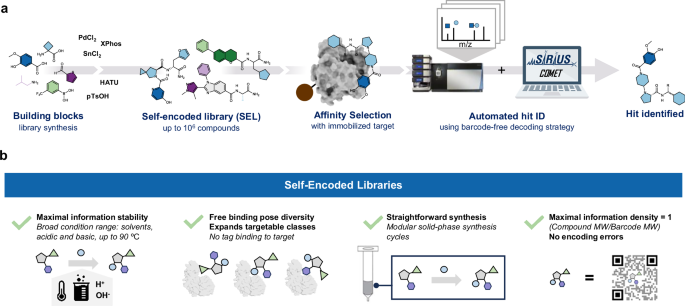
Detailed methods, synthetic procedures, compound characterization, building block selection, library enumeration and COMET are described in the Supplementary Information.
Library synthesis
SEL 1
TentaGel S NH₂ resin (30 µm, 0.24 mmol/g loading, 2.625 g, 630 µmol, 1.0 eq.) functionalized with Fmoc-Rink Amide linker was over-divided over 62 fritted syringes. A solution of each Fmoc-protected amino acid AA1-AA62 (30 μmol, 3.0 eq), HATU (29.8 μmol, 0.4 M, 2.98 eq) and DIPEA (90 μmol, 9.0 eq) in DMF was added to the resin and reacted for 2 h. The resin was pooled and washed with DMF (5 × 2 mL) and 20% piperidine in DMF (1 × 2 mL) before incubating with 20% piperidine in DMF for 10 min. The resin was washed with DMF (5 × 2 mL) and split over 62 fritted syringes.
The second building block was incorporated using the same reaction conditions. A solution of each Fmoc-protected amino acid AA1-AA62 (30 μmol, 3.0 eq), HATU (29.8 eq. 0.4 M, 2.98 eq) and DIPEA (90 μmol, 9.0 eq) in DMF was added to the resin and reacted for 2 h. The resin was pooled into a fritted syringe (20 mL) and washed with DMF (5 × 2 mL) and 20% piperidine in DMF (1 x 2 mL) before incubating with 20% piperidine in DMF for 10 min
For the incorporation of the 3rd building block, the resin (350 μmol, 1.0 eq) was divided over 130 Eppendorf tubes. A solution of each carboxylic acid CA1-CA130 (8.08 μmol, 3.0 eq), HATU (80.2 μL, 0.1 M, 8.02 μmol, 2.98 eq) and DIPEA (4.22 μL, 24.23 μmol, 9.0 eq) in DMF was added to the resin (2.69 μmol). The reactions were stirred overnight at r,t. The resin was pooled and washed with DMF (5 × 2 mL) and DCM (5 × 2 mL).
The resin was incubated for 1.5 h with a solution of TFA:H2O:TIPS (92.5:5:2.5) and washed once with a solution of TFA:H2O:TIPS (92.5:5:2.5). TFA was evaporated under a stream of N2, and the library was purified using reverse phase column chromatography with a stepwise gradient of 00-70-100% MeCN:H2O (0.1% TFA).
SEL 2
TentaGel S NH₂ resin (30 µm, 0.24 mmol/g loading, 2.625 g, 630 µmol, 1.0 eq.) functionalized with Fmoc-Rink Amide linker was over-divided over 62 fritted syringes. A solution of each Fmoc-protected amino acid AA1-AA62 (30 μmol, 3.0 eq), HATU (29.8 μmol, 0.4 M, 2.98 eq) and DIPEA (90 μmol, 9.0 eq) in DMF was added to the resin and reacted for 2 h. The resin was pooled and washed with DMF (5 × 2 mL) and 20% piperidine in DMF (1x, 2 mL) before incubating with 20% piperidine in DMF for 10 min. The resin was washed with DMF (5 × 2 mL) and a solution of 4-fluoro-3-nitrobenzoic acid (175 mg, 945 μmol, 3.0 eq), HATU (2.346 mL, 939 μmol, 2.98 eq) and DIPEA (494 μL, 2.835 mmol, 9.0 eq) in DMF was added to the resin. After 1 h, the reaction was washed with DMF (5 × 2 mL). The resin was divided over 52 Eppendorf tubes, to which amines AM1-AM52 (59.6 µmol, 10 eq.) and DIPEA (10.55 µL, 59.6 µmol, 10 eq.) in DMF (150 µL, 0.4 M) were added. The mixture was shaken at 1 x g overnight at 80 °C. The resin was pooled and washed with DMF (5 × 2 mL) and DCM (5 × 2 mL). A solution of 1.0 M SnCl2 (3.73 g, 19.7 mmol, 62.5 eq.) in DMF was added to the resin (315 μmol). The mixture was incubated overnight at r.t., whereafter the resin was washed with DMF:H2O (1:1, 5 × 2 mL), with DMF (5x, 2 mL) and DCM (5x, 2 mL). The resin (4.31 µmol, 1.0 eq.) was split over 67 Eppendorf tubes to which the appropriate aldehyde AL1-AL67 (0.25 M in DMF (103.3 μL), 25 µmol, 5 eq.) and p-TsOH•H2O (4.76 mg, 25 µmol, 5 eq.) were added. The mixture was incubated overnight at 1 x g, overnight at r.t. After incubation, the resin was washed with DMF (5 × 2 mL) and DCM (5 × 2 mL). The resin was incubated for 1.5 h with a solution of TFA:H2O:TIPS (92.5:5:2.5) and washed once with a solution of TFA:H2O:TIPS (92.5:5:2.5). TFA was evaporated under a stream of N2, and the library was purified using reverse phase column chromatography with a stepwise gradient of 00-70-100% MeCN:H2O (0.1% TFA).
SEL 3
TentaGel S NH₂ resin (30 µm, 0.24 mmol/g loading, 1.1 g, 265 µmol, 1.0 eq.) functionalized with Fmoc-Rink Amide linker was over-divided over 60 fritted syringes. A solution of each Fmoc-protected amino acid (Supplementary Table 12) (12.8 μmol, 3.0 eq), HATU (12.7 μmol, 0.4 M, 2.98 eq) and DIPEA (38.5 μmol, 9.0 eq) in DMF was added to the resin and reacted for 4 h. The resin was pooled into a fritted syringe (20 mL) and washed with DMF (5 × 2 mL) and 20% piperidine in DMF (1x, 2 mL) before incubating with 20% piperidine in DMF for 10 min. The resin was divided over 10 Eppendorf tubes. A solution of aryl bromide AB1-AB10 (26.50 μmol, 3.0 eq), 0.4 M HATU (78.97 μmol, 197 μL, 2.98 eq), DIPEA (41.50 μL, 238.5 μmol, 9.0 eq) and DMF (400 μL) was added to the resin (26.50 μmol). After 4 h, the resin was washed with DMF (5 × 2 mL). Aryl bromide AB10 was deprotected by washing with 20% piperidine in DMF (1x, 2 mL) before incubating with 20% piperidine in DMF for 10 min. A solution of benzoic acid (9.7 mg, 79.50 μmol, 3 eq.), DIPEA (41.50 μL, 238 μmol, 9.0 eq) and DMF (400 μL) was added to the resin containing AB10 (26.50 μmol) and reacted for 1 h. The resin was combined in a fritted syringe and was washed with DMF (5x). The resin was divided over 53 Eppendorf tubes. Boronic acid BA1-BA53 (10 μmol, 2.0 eq.), K2CO3 (1.4 mg, 10 μmol, 2.0 eq.), PdCl2 (89 μg, 0.5 μmol, 10 mol%), XPhos (0.48 mg, 1 μmol, 20 mol%) and DMF (100 μL) were added to the resin (5.0 μmol). The reaction was stirred at 1 x g at 80 °C for 21 h. The resin was washed with DMF (5 × 2 mL) and DCM (5x) and incubated for 1:45 h with a solution of TFA:H2O:TIPS (92.5:5:2.5). The resin was washed once with a solution of TFA:H2O:TIPS (92.5:5:2.5), whereafter the TFA was evaporated. The library was purified using reverse phase column chromatography with a stepwise gradient 00-70-100% MeCN (0.1% TFA).
SEL 4
TentaGel S NH₂ resin (90 µm, 385 mg, 0.26 mmol/g, 100 μmol, 1.0 eq.) functionalized with Fmoc-Rink Amide linker was over-divided over 20 fritted syringes. A solution of each Fmoc-protected amino acid (Supplementary Table 15) (15 μmol, 3.0 eq), HATU (0.4 M, 2.98 eq) and DIPEA (9.0 eq) in DMF was added to the resin and reacted for 2.5 h. The resin was pooled and washed with DMF (5 × 2 mL) and 20% piperidine in DMF (1 × 2 mL) before incubating with 20% piperidine in DMF for 10 min. The resin was washed with DMF (5 × 2 mL) and split over 20 fritted syringes. The second building block was incorporated using the same reaction conditions. A solution of each Fmoc-protected amino acid (Supplementary Table 15) (15 μmol, 3.0 eq), HATU (0.4 M, 2.98 eq) and DIPEA (9.0 eq) in DMF was added to the resin and reacted for 2.5 h. The resin was pooled into a fritted syringe (20 mL) and washed with DMF (5 × 2 mL) and 20% piperidine in DMF (1x, 2 mL) before incubating with 20% piperidine in DMF for 10 min
For the incorporation of the 3rd building block, the resin was divided over 10 syringes. A solution of each carboxylic acid (Supplementary Table 16) (30 μmol, 3.0 eq), HATU (149 μL, 0.2 M, 29.80 μmol, 2.98 eq) and DIPEA (15.7 μL, 90 μmol, 9.0 eq) in DMF was added to the resin (10 μmol) and reacted for 2.5 h. The resin was pooled and washed with DMF (5 × 2 mL) and DCM (5 × 2 mL).
The resin was incubated for 1.5 h with a solution of TFA:H2O:TIPS (92.5:5:2.5) and washed once with a solution of TFA:H2O:TIPS (92.5:5:2.5). TFA was evaporated under a stream of N2, and the library was purified using reverse phase column chromatography with a stepwise gradient of 00-70-100% MeCN:H2O (0.1% TFA).
Affinity selection mass spectrometry
A KingFisher™ Duo Prime Purification System was used to perform our affinity selection experiments. The protocols were developed with BindIt 4.1 Software. Affinity selection experiments against CAIX were performed in duplicates with protein (150 pmol) immobilized on Dynabeads MyOne Streptavidin T1 (1 mg) and library (100 fmol/member) with the King Fisher protocol as described in Supplementary Fig. 19, unless stated otherwise. Affinity selection experiments against FEN1 were performed in duplicates with protein (150 pmol) immobilized on Dynabeads™ His-Tag Isolation and Pulldown (1 mg) and library (1 pmol/member) with the King Fisher protocol as described in Supplementary Fig. 19.
Samples from the affinity selection procedure were lyophilized and resuspended in 50 µL MQ 0.1%FA. The StageTips were prepared as described by Rappsilber et al. using C18 material from Empore SPE 47 mm disks (66883-U, Merck)48. The StageTips were pre-conditioned with 200 µL MeOH, 200 µL of 0.1% (v/v) FA in MeCN and 200 µL of 0.1% (v/v) FA in MQ, respectively, by centrifuging for 3 min at 300 x g. The samples were then loaded on the StageTips and washed with 200 µL of 0.1% (v/v) FA in MQ. Compounds were eluted by adding 200 µL of 0.1% (v/v) FA in MeCN:MQ (7:3). The samples were lyophilized before resuspending in 10 µL 0.1% (v/v) FA in UPLC-MS grade water. The samples were centrifuged for 5 min at 21,000 x g. Afterwards, 9 µL was transferred to a LC-MS vial and 8 µL was injected into the LC-MS/MS system. Additional details are reported in Supplementary Chapters 8 and 9.
COMET
COMET software is available through GitHub ( Enumerated libraries generated by the above KNIME workflow were imported into COMET as custom structure databases using the GUI. Spectra files were imported as.mzML files and background subtraction was performed using the “Tags” panel in the general filter dialog window of the GUI using the following settings; MS1 m/z accuracy = 5 ppm, RT accuracy = 10 s and max intensity ratio = 3 (see Supplementary Fig. 20). Features from actual samples that also appeared in the control runs within a two second retention time tolerance, a five ppm mass deviation tolerance, and a fold change of less than two were removed. The COMET filter can be accessed through the same filter dialog window, where a separate section for COMET is provided (Supplementary Fig. 20). For its application, we used the following settings: scaffold formula: C8H3N2O for SEL 2 and left blank for SEL 1, 3 and 4, MS1 mass accuracy (ppm) = 5 ppm, considered fragment types = SEL 1: S[0;1], S[1;2],0,2, SEL 2: S[0;2], S[1;2],0,1, SEL 3: S[1:2],0, SEL 4: S[0;1], S[1;2],0,2 minimum number of matching peaks = 1, number of considered peaks = 5, number of allowed hydrogen shifts = 1, MS2 mass accuracy (ppm) = 5. The specification of such fragment types is illustrated in Supplementary Fig. 22. For each library, a file containing information about all the library’s building blocks has to be provided in COMET. These.csv files were generated using the Python script “COMET_Building blocks_input.ipynb” which is available through Zenodo ( See Supplementary Chapter 4.1 for method details on the COMET filters. Molecular formula generation in COMET was performed using formula database search in the imported custom library; all other settings were left to default. After fingerprint prediction (score threshold enabled), the imported custom library was used for structure database search. Structure candidates were ranked according to EPIMETHEUS, see Supplementary Chapter 4.5, for method details.
Biolayer interferometry (BLI)
Purified biotinylated compounds were dissolved to 1 μM in 1x PBS, 0.02% Tween-20, 1 mg/ml BSA (0.1% (w/v)) (kinetic buffer) used for immobilization onto streptavidin Octet SA Biosensors (SATORIUS). Biolayer interferometry (BLI) assays were performed in 96-well plates (GreinerBio-One, polypropylene, flat-bottom, chimney well) using an Octet R4 system (SATORIUS). Wells were filled with 200 μL of kinetic buffer, compound solution or CAIX solution.
Biotinylated compound was immobilized onto the streptavidin biosensor for 60 s. Sensors were then dipped into kinetic buffer for 60 s, CAIX solution (500 nM, 250 nM, 125 nM, 62.5 nM) for 600 s and into kinetic buffer for 600 s. Measurements were carried out at 30 °C.
FEN1 activity assay
The assay was performed based on literature49. The assay was performed in Corning black 384-well plates (no. 3820). The assay buffer contained 20 mM HEPES pH 7.5, 100 mM KCl, 5 mM MgCl2, 0.1 mM DTT, 200 µg/mL BSA and 0.01% NP-40. The substrate consists of an oligonucleotide with Cy3 as a fluorophore. In each well, substrate (200 nM), FEN1 (125 pM) and were incubated with decreasing concentration of hits. The FP signal was read on a BMG PHERAstar.
Docking
Using published ligand-bound x-ray crystal structure of FEN1 (PDB: 5FV7) in pharmacophore modeling tool ‘Pharmit’50, four pharmacophore interactions were defined in the bound ligand. These interactions served to constrain ligands to form comparable interactions with the 2 x Mg2+ ions, while no constraint would be placed on the orientation or position of the additional building blocks present in the hit. Two H-bond acceptors were defined for the carbonyls of the hydroxyurea. The hydroxy group was assigned as an H-bond donor (modeling was performed with the hydroxyurea as a neutral species). Finally, the urea-containing 6-membered ring was defined as an aromatic pharmacophore. Next, conformations for ASMS hits 6 and 7 were generated in Pharmit and conformers were aligned with the prepared pharmacophore model. >40 conformations were found as matches. Next, an energy minimization step was performed, and an energy score filter (<−6) and maximum mRMSD (4.0) was set to eliminate low-quality poses.
Reporting summary
Further information on research design is available in the Nature Portfolio Reporting Summary linked to this article.
link